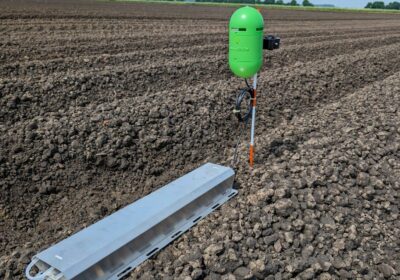
Photosynthetic photon efficacy (PPE) is a complex concept that can play a significant role in managing spectrum and plant growth in different agricultural environments. It has evolved around discussions of PAR and different grow light models and how these different definitions and applications influence plant health, quality and growth.
“The term efficacy applies to ratios within different units. In horticultural lighting, efficacy refers to micromoles of photon output per second, per watt of input power.” – ‘From physics to fixtures to food: current and potential LED efficacy, Nature.
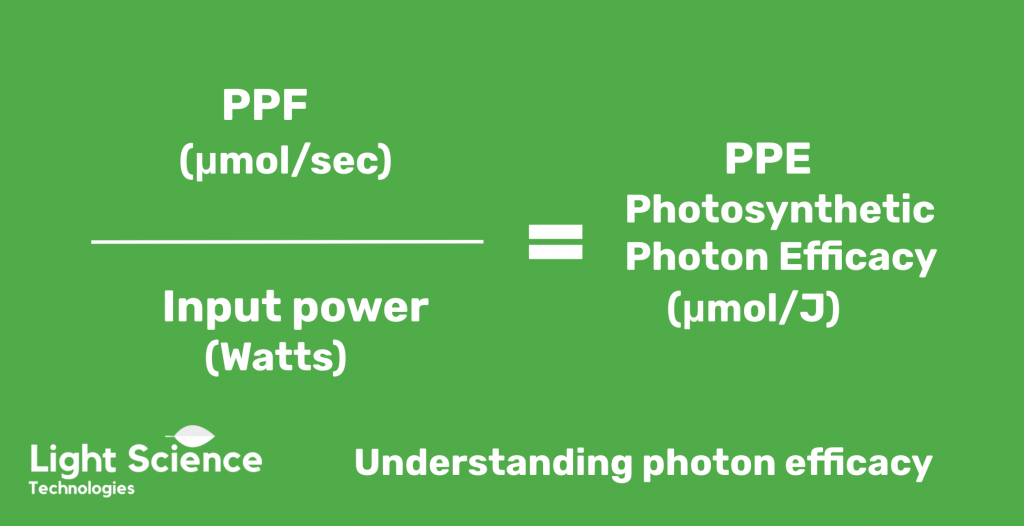 The formula for photon efficacy is defined as ‘The photosynthetic photon efficacy (Kp) is the photosynthetic photon flux divided by input electric power. The unit is micromoles per second per electric watt (μmol × s-1 × We-1), or micromoles per joule (μmol × J-1)’ according to Hortidaily.
The formula for photon efficacy is defined as ‘The photosynthetic photon efficacy (Kp) is the photosynthetic photon flux divided by input electric power. The unit is micromoles per second per electric watt (μmol × s-1 × We-1), or micromoles per joule (μmol × J-1)’ according to Hortidaily.
What does Photosynthetic photon efficacy (PPE) mean for the grower?
Efficacy is a concept that can help you optimise and transform your grow light investments and your crop yields. To fully realise its value, you need to have a clear understanding of:- Photosynthetically active radiation (PAR) and how its spectral range influences plant growth and development.
- Photosynthesis and how this process can be manipulated by the intelligent usage of grow lights and wavelength modifications.
- Photosynthetic photon efficacy (PPE) as it applies to PAR and the different types of grow lights available on the market.